

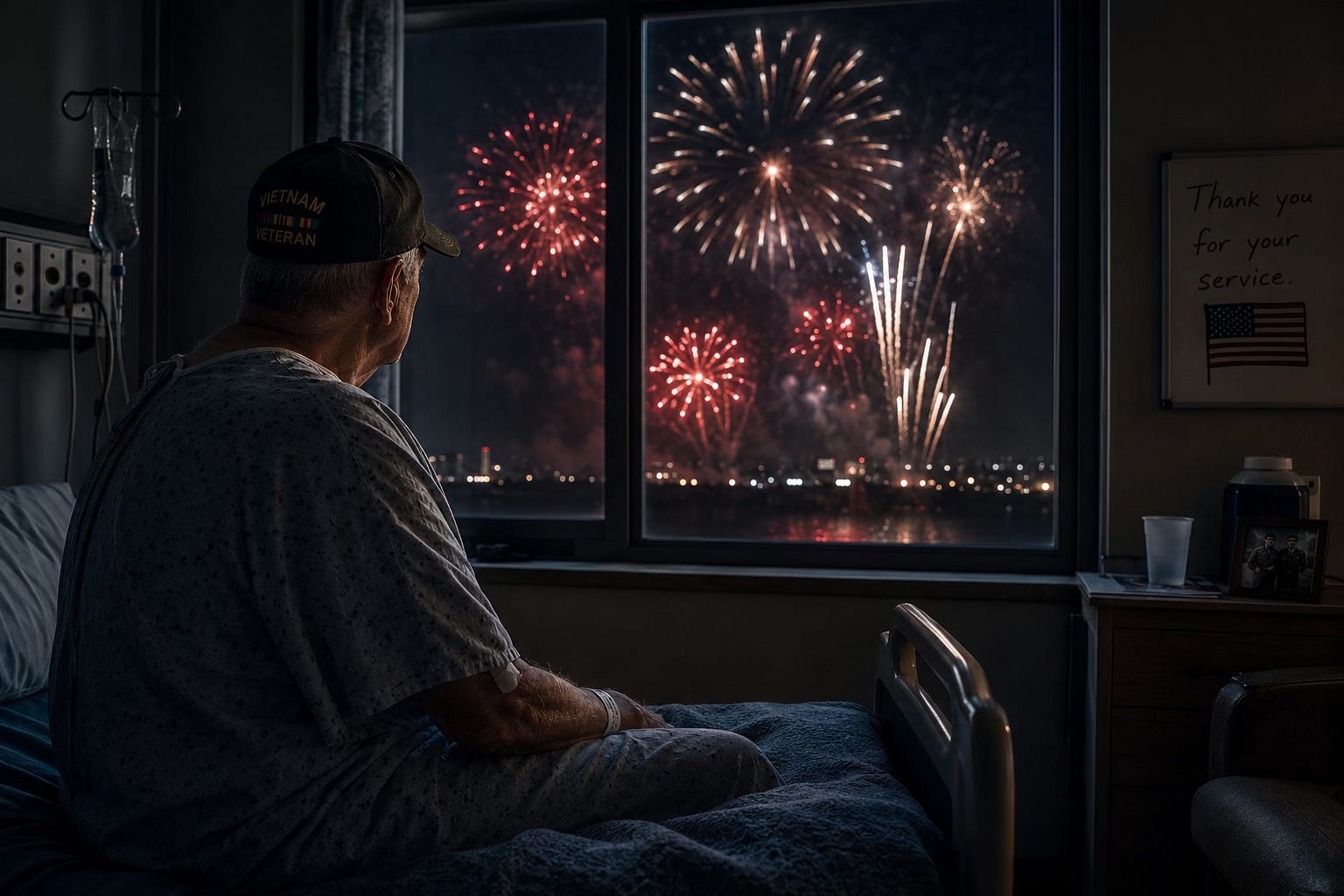
Since its founding, the United States has participated in wars that caused the deaths of an estimated 1.1 to 1.3 million American service members across all conflicts, from the Revolutionary War through Iraq and Afghanistan. Civilian and foreign deaths tied to American wars are vastly higher and impossible to calculate precisely. The post-9/11 wars alone are estimated to have killed around 940,000 people directly, while costing roughly $8 trillion.
And still the country unfolds lawn chairs beneath fireworks.
But the country does not unfold its lawn chairs despite the dead; it unfolds them because of the dead. The fireworks are not a celebration of freedom; they are a desperate, brilliant scream into the night, meant to ensure that the ground stays firmly over the mouths of the ones who paid for the lawn.
Every nation, at the end of its career, is characterized by a collective fatigue, a refusal to look at its own ghosts.
A civilization eventually reaches the point where it can no longer distinguish remembrance from advertising.
On May 24, 2026, Ashley Furniture runs a Memorial Day sale. “Unbelievable discounts,” the banner reads. No interest for 60 months on purchases of $3,499 or more. The website promises “endless savings” on mattresses. A queen-size Nectar Memory Foam that normally costs $1,200 drops to $699. $501 off. Free pillows with purchase.
The holiday combines genuine grief with discounted patio furniture without noticing the contradiction.
Somewhere beneath the supermarket banners and automotive sales events lies the faint memory that this nation was assembled from corpses.
Literally.
The United States began in war, expanded through war, unified itself through war, industrialized through war, globalized itself through war, and now sustains its empire through wars so distant the average citizen experiences them only as fluctuations in gasoline prices or brief yellow ribbons attached to suburban mailboxes.
The dead are just added invisibly now.
That is modernity’s greatest achievement. Not comfort. Not technology. Camouflage.
The most successful camouflage is not green or brown; it is neon. To hide a slaughterhouse, you do not build a wall, you build an amusement park on top of it and sell tickets to the descendants of the slaughtered.
America perfected camouflage. It learned to place oceans, media systems, bureaucracy, pharmaceuticals, entertainment, and language itself between the population and mortality.
Ancient societies were brutally honest. They forced civilians to confront the consequences of violence directly. Limbless veterans sat in public squares. Mothers washed bodies with their own hands. Cities smelled like funeral smoke. Death occupied geography and refused to be ignored.
Roman Empire did this. Athens did this. Jerusalem did this.
The dead were not hidden. They were displayed.
The cost was visible.
The consequence was immediate.
You could not forget because you could not escape the smell.
Collateral damage.
Force projection.
Neutralized targets.
History is nothing but a procession of false absolutes, a series of temples raised to pretexts, a degradation of the mind before the improbable.
Since 1776, more than a million American soldiers have died in war. The Civil War alone consumed approximately 620,000 to 750,000 bodies depending on the estimate. World War II killed over 400,000 Americans. Vietnam over 58,000. Korea around 36,000. Iraq and Afghanistan: 6,700 American deaths. But 52,010 wounded. At least 7,950 private contractors dead. And millions more foreign dead, direct and indirect, across Afghanistan, Iraq, Syria, Yemen, and Pakistan.
The precision of the numbers is meaningless.
And that is the point.
Twenty to twenty-two veterans commit suicide every single day.
Vietnam veterans have a 30.9% PTSD rate. Gulf War veterans: 12.1%. Operation Enduring Freedom: 13.8%.
The medications:
Sertraline. Zoloft. Paroxetine. Paxil. Fluoxetine. Citalopram.
The side effects are documented: nausea, insomnia, tremors, sexual dysfunction, seizures, emotional instability, suicidal ideation.
In other words: the cure for what the war did to your brain may begin destroying other parts of you instead.
Veterans with PTSD are prescribed multiple psychiatric medications at staggering rates.
The treatment begins to resemble the wound.
War does not merely destroy bodies. It rearranges the perception of reality.
A man returns home from Fallujah and discovers grocery stores feel unreal.
Another drinks because silence to him signals an ambush.
Another cannot explain why his daughter’s birthday balloons trigger panic every time one pops.
Another survives physically while remaining psychologically stranded in a city that no longer exists except in dreams.
The worst casualty of never ending war is not the body that is buried, but the mind that returns home and discovers that home was the most violent illusion of all.
For a unilateral lower-limb amputation from operations in Iraq and Afghanistan, the five-year projected cost of prosthetics and assistive devices is $228,665. A single leg. For bilateral amputation the figure jumps to $453,696.
The VA provides this. An annual clothing allowance for prosthetic wear damage.
This is a nation’s thanks: a clothing allowance. A check.
Civilization prefers we call these conditions disorders because civilization prefers medical terminology to existential recognition. But perhaps many veterans are not disordered at all. Perhaps they have simply seen existence too directly to resume participation in the national hallucination afterward.
This is what countries truly fear about veterans.
Not violence.
Clarity.
A man who has watched twenty-year-olds die screaming inside burning vehicles becomes difficult to impress with corporate slogans or political theater. He has already seen underneath abstraction. He knows nations speak about glory while operating primarily through logistics, contracts, fuel, steel, and replacement rates.
Even patriotism changes form after enough death.
At first patriotism resembles love. Later it resembles grief. Eventually it looks like exhaustion.
Memorial Day exists partly to prevent this realization from spreading too far. The holiday converts catastrophe into ritual manageable enough for public consumption.
Flags. Ceremonies. Flyovers. Carefully regulated sadness. Then quickly back toward sales, sports, and alcohol before reflection deepens into dangerous territory.
Because serious remembrance always becomes destabilizing eventually.
We are all accomplices to the silence.
To offer a discount on a mattress to commemorate a massacre is the most honest thing this civilization does. It acknowledges that our comfort is the only absolute we recognize.
Ashley Furniture’s $501 discount on the Nectar mattress is not cruelty. It is clarity.
The nation is saying:
We understand that you need to sleep.
We understand that you need soft things.
We understand that you need to forget.
Here is your mattress. Here are your free pillows.
Sleep well.
Do not think about the dead.
If Americans truly understood what war cost, they might begin questioning the lies surrounding them. They might notice that empires survive by distributing sacrifice unevenly. Some people inherit comfort while others inherit trauma.
Empires require psychological distance the same way engines require fuel.
And perhaps that is the final horror.
The dead rarely remain dead.
Not spiritually.
Not historically.
They persist beneath civilization itself. Every highway, suburb, stadium, shopping mall, university, corporation, and political institution rests partly upon unnamed bodies absorbed into the foundation.
Nations are not built merely through constitutions and ideals. They are built through funerals.
Memorial Day attempts, briefly, awkwardly, almost accidentally, to acknowledge this.
Then the advertisements begin again.
Fifty percent off. Limited time only. Freedom sale.
As though the country itself fears silence long enough for the graves to answer back.
But the final silence will not be a peaceful one. It will be the sound of millions of people suddenly realizing that the music has stopped, the lights have gone out, and the bill for the empire has finally come due.
Epilogue
And still, despite all of this, there are people who refuse to abandon them.
Not governments. Not corporations. Not slogans.
People.
Volunteers sending groceries. Former soldiers answering crisis calls at two in the morning because they recognize the silence on the other end. Small organizations paying for motel rooms, prescriptions, winter coats, prosthetic repairs, utility bills, funerals. Veterans sitting across from other veterans in folding chairs, trying to keep each other alive one conversation at a time.
There are still hands reaching back into the darkness.
Because after the speeches end and the flags are folded away, many veterans return to lives shaped by unemployment, addiction, PTSD, isolation, chronic pain, divorce, homelessness, and the strange permanent dislocation that follows war home like a shadow.
Society applauds sacrifice in abstraction. It is less enthusiastic about living beside its consequences.
So others stepped in.
Quietly.
Without flyovers. Without parades. Without sales events.
They pick up where the country looked away.
They drive men to VA appointments. They raise emergency rent money. They sit through panic attacks. They answer late-night phone calls that begin with long silences and end with someone deciding to survive one more night.
This is not charity. It is repair work.
The empire creates wounds faster than institutions can heal them, and so ordinary people inherit the responsibility.
Veterans supporting veterans.
Communities supporting veterans.
Human beings refusing to let one another disappear.
Perhaps that is the only real form of patriotism left: not waving flags above the dead, but standing beside the living who returned carrying pieces of the dead inside them.
The country may camouflage war beneath neon, discounts, and ceremony.
But there are still people willing to kneel in the ruins and do the unglamorous work of remembering.
Not once a year.
This is solemn, haunting, and written with so much depth. 🥹