

The air is ripped from your lungs.
You look up from the bottom of a raw, vertical scar of coral and limestone. Four hundred feet of jagged gray teeth loom out of the Okinawan dirt. The enemy is buried deep inside the mountain itself, chiseled into the rock, breathing through hidden vents, waiting behind slits for the next wave of soldiers
Your fingers bleeding, raw against the wet rope of the cargo nets. Every boots-up step drags like an anchor through sucking mud. Above you, the sky is a ceiling of supersonic snaps. Thwip. Thwip. Crack. Lead parts the air inches from your ears.
Your boots hit the top, and the world goes violently deaf.
A physical blow rips the breath straight out of you. The ground explodes. The Japanese burst from the limestone like angry ghosts, screaming into the smoke. The noise is a wall. Sound becoming physical. The frantic, mechanical hammer of Nambu machine guns drilling holes through flesh, the heavy, wet thud of mortars tearing the dirt apart.
The stench hits the back of your throat and stays there. Burning wool. The bitter, chemical reek of cordite metallic on the tongue. Under it all is the thick, hot, unmistakable stink of open bellies, ruptured bowels, and scorched skin.
Men disintegrate. A high-pitched, wet gurgle cuts through the roar to your left. A boy from Iowa holding his own throat together, his fingers slipping in the grease of his own blood. The dirt under your knees is a red porridge of mud, shredded ponchos, and human gristle.
Right through the middle of this butchery moves Desmond Doss.
He is twenty-six, built like a reed, his hands shaking. His uniform is a stiff, blackened rag, soaked through with sweat and stiffening with the blood of men already dead. His eyes are raw, bloodshot, sunk so deep into dark, hollow sockets they look like burn holes in a sheet. His breath comes in ragged, wheezing gasps, his chest heaving under a mix of fear and effort.
He is alone. He is unarmed.
A jagged scream rips through the roar. A feral, animal shriek of a man realizing he is being left behind in the dirt. Doss launches himself forward, his boots slipping on wet rocks, throwing his body flat into the mud as a burst of machine-gun fire shears the grass an inch above his helmet.
He crawls on his belly through the human wreckage. He reaches a boy whose legs have been turned to something unrecognizable to someone not accustomed to this war. Doss digs his fingers into the boy’s slick uniform, grits his teeth, and drags him. The rock tears at Doss’s knees, ripping through the canvas of his trousers, leaving a trail of his own skin on the coral.
He drags him to the lip of the abyss. His fingers, slick with red mud, fumble with the hemp rope, knotting it into a makeshift sling. He lowers the boy down the sheer cliff face, his muscles screaming, the rope burning white-hot grooves into the palms of his bare hands.
Then he does the unimaginable. Then he turns around and looks back into the smoke.
Seventy-five times. Seventy-five separate descents into a meat grinder where his only shield against a sniper’s crosshairs is the limp, heavy body of the bleeding man he’s hauling on his back. He is locked onto the wet, terrified grip of a nineteen-year-old holding his hand, begging to survive.
When a man screams, you answer.
Even when the world is ending around you.
That is the bleeding edge of what we demanded of him. That is the ghost that followed him home.
Years later, when he needs help, he won’t ask.
The shame isn’t about anything but weakness.
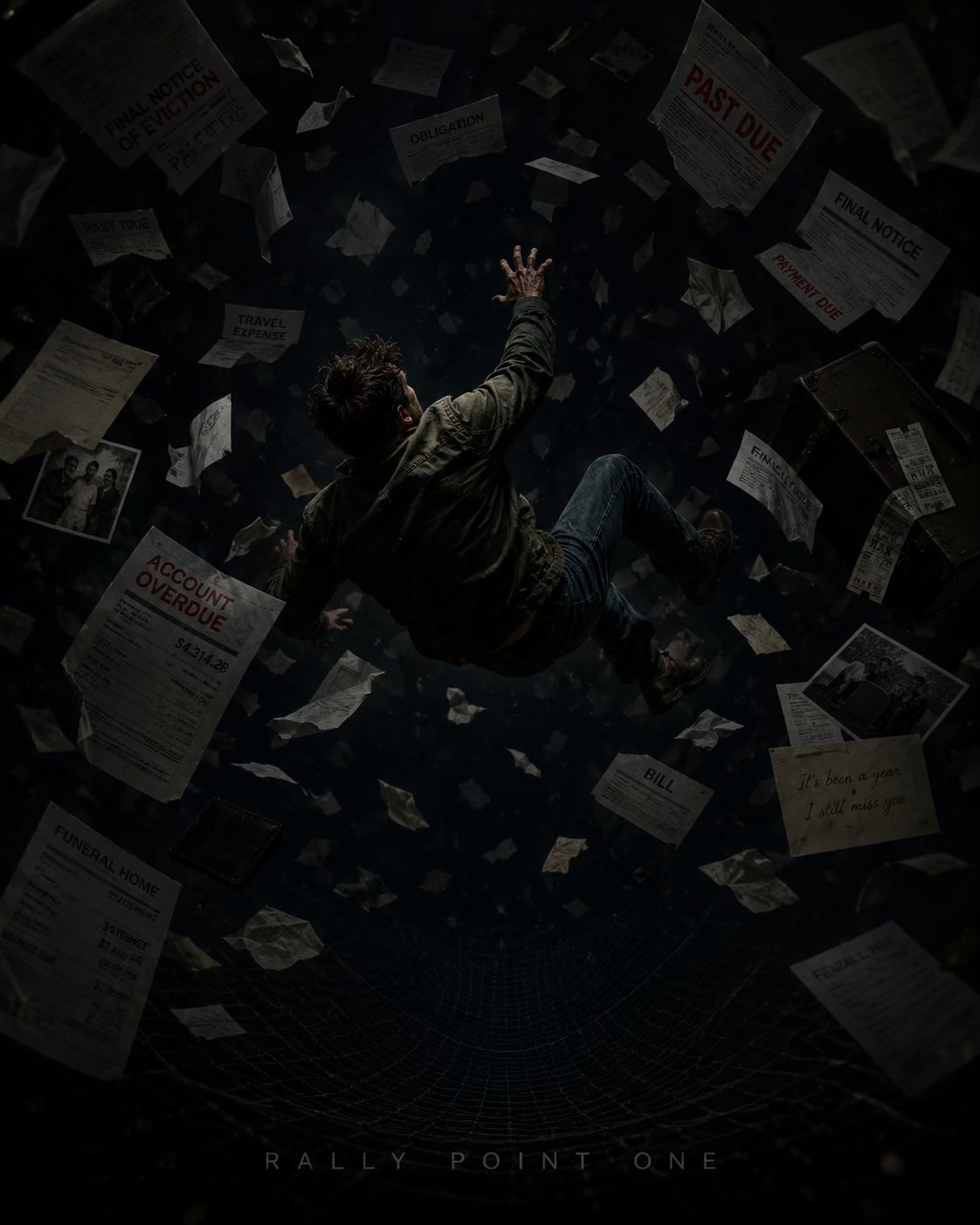
It’s about the virtues we installed in him. Put others first. Carry the burden yourself. Your life comes last. These are the exact virtues that made men save seventy-five men under fire. They’re also the virtues that make him starve before asking for groceries. That make him lose his house instead of calling for help.
The very things that made him heroic become the a prison in another world.
The system moves slow. Bureaucracy requires waiting. By the time help arrives from the traditional channels, the crisis has become something else. The rent is due tomorrow. The power gets cut. The family eats less. The home is sold.
Or worse, the person reaches a point where the only way out is the permanent one.
This happens because veterans are trained to carry others, and we’ve built systems that require them to wait, patiently, while they drown.
Rally Point One does something different.
A veteran calls. His father has died. He can’t afford the flight home. The funeral is in three days. His family is gathering. He should be there. He should stand in a cemetery and bury his father and grieve with his brothers and sisters.
Instead he’s making calculations. I don’t have the money. I’m working a job that doesn’t pay much. If I buy the ticket, I skip rent. I use credit I can’t pay back. I tell my family I can’t come.
Rally Point One buys the ticket. We don’t ask him to fill out forms. We don’t ask him to prove he’s desperate. We act because in that moment, waiting means his father gets buried without him there.
We buy the flight. We don’t make him wait. We don’t ask him to prove he’s desperate enough. We act the same day because in that moment, waiting is the same as saying no.
That’s what Rally Point One is. We’re the filler between the moment someone needs help and the moment they get it. We’re the difference between losing your home and keeping it. Between your family eating this week or going hungry. Between being able to bury your father and missing it because you can’t afford the cost.
We’re the moment that saves a life.
We’re the movement that believes ‘I need help’ should not be the most painful sentence a man or woman speaks.
Support us by joining our subscriber list or HERE or HERE.
Proceeds go into the hands of someone that cannot wait. Thank you.