

The first shell sails over the lake into the embers of the western sky, one streak climbing its own smoke trail, and the boom follows full second behind the flash. Somebody’s kid could not wait for the setting sun. Along the shoreline the grills are going, smoke off the charcoal, sunscreen on hot skin, cut grass, the green weedy breath of the lake itself, and then the show opens, chrysanthemums of gold and green blooming above the water and doubled on it, so the sky happens twice. When the wind swings in off the water you can taste the powder. Kids run the outfield grass with sparklers, writing their initials on the dark and losing them. A man in a lawn chair tips his head back and tells nobody that this one is the best one yet. He says it every year.
Every year it is true.
This is one America, and there is nothing wrong with it. The watermelon rind in the grass, the cooler lid slamming all evening, the baby asleep on a shoulder in headphones two sizes too big, the teenagers embarrassed to be seen with their parents and staying anyway. If you have ever stood in that crowd when the finale lets go and felt it in the soles of your feet, you know it is a wonderful thing and worth having. I am not going to tell you otherwise.
The same night is happening somewhere else.
Three streets from the ballfield, in a brick building with window units dripping its moldy residue into an alley, one apartment remains dark. The man inside keeps the television off because he wants to hear the gaps between the explosions. He counts them without thought. His dog crawled under the bed an hour ago and will not come out for anything, even bacon. He is not afraid, and he would tell you that, and it would be true. It is the flinch he hates, the way his shoulders climb toward his ears before he even registers the sound. Nineteen years since anyone shot at him and he still knows outgoing from incoming without trying. So he sits in the dark with his hand hanging off the mattress where the dog can smell it, and he wait.
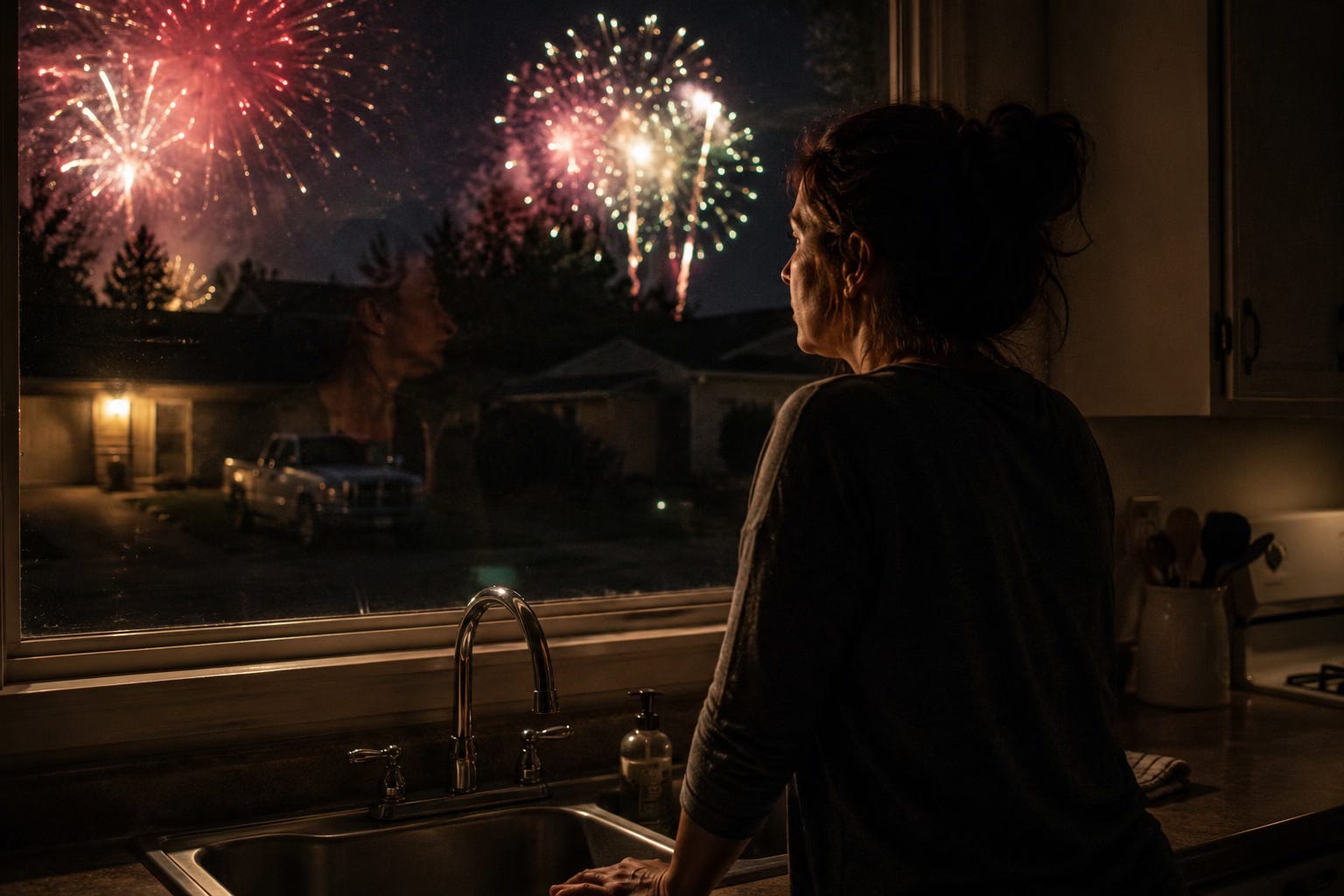
Across town a woman stands at her sink not washing anything. She has the window open. She is listening for a truck. She knows its sound the way you know a child’s voice, and she knows the difference between the sound of it pulling in easy and the sound of it idling while her husband decides whether he can do this. The Fourth is the worst one. New Year’s is bad. The Fourth is worse, all that joy detonating overhead for hours, and him in the basement last year with the lights off telling her through the door that he was fine. Fine. Fine. She left a plate of food outside that door, a meal for a man imprisoned by his own dreams. Tonight he is not home yet, and the first shells are exploding, and she stands at the window, listening.
In a subdivision west of the highway, a phone rings at a barbecue and a man steps away from his own guests to answer it. The voice on the other end gets five words out. I don’t think I can. That is as far as it goes. The man is already inside finding his keys. He drives across town with the windows, both loving and hating the finale as it goes off over the interstate. He takes the exit, gold light sliding across his windshield, but he looks no more. He has made this trip before. He knows the job. Presence, before anything else gets said. He parks in a rush and takes the stairs.
In a ranch house with a flag out front, a family eats early so they can get to the fairgrounds, and the mother sets the table for five though there are four of them now and have been for two years. Nobody says a word, the glances say it all. The plate sits there through the burgers and the corn, catching the evening light, and when they clear the table the father takes that plate himself, rinses it, dries it, and puts it back in the cabinet with a care he shows nothing else in his life. Then they load the cooler into the van and go watch the show like everybody else. Both things live in that house, the celebration and the emptiness. They learned a while ago that one does not cancel the other.
An emergency waiting area on the north side smells like disinfectant and burnt popcorn. A young wife has been in the same hard chair for three hours. Through the glass doors she can see other people’s fireworks over the parking structure, small and silent from here, like a TV on mute. Her husband came home from his second deployment six years ago, and tonight he traveled in a different way, in the back of an ambulance, and she is out here rehearsing what she will tell his mother while the sky blooms over the parking structure as if none of this were happening, because in one America it is not.
On a counter in a third floor walkup there is an envelope from the Department of Veterans Affairs that has been there eleven days. The man who lives there moves it when he wipes the counter and puts it back in the same spot, squared to the counter’s rim. He is not lazy and he is not disorganized. He knows that whatever is inside is a decision, a percentage, a number that will tell him what the worst year of his life was worth, and he is not ready to know. So the envelope sits under the window while the neighborhood pops and flashes, and he watches a movie he has seen thirty times with the volume all the way up.
And in a driveway in the suburbs a car sits with its motor off and a man in the driver’s seat. He has been home from the cookout for twenty minutes. Through the front window he can see his wife moving, and he can hear, faintly, the last rockets going off two streets over. The dome light timed out a while ago. Inside that house is everything he came back for, and he cannot make himself pull the door handle, and he could not explain this to anyone who has never sat in this seat. He flew missions. He walked roads that were not roads. Getting out of this truck and going inside and being a husband tonight is harder than any of it. So he sits, and breathes, and eventually he goes in, the way he does always does, and his wife does not ask, because she knows what those twenty minutes are.
Nobody at the ballfield will witness any of this, and there is no crime in that.
There is a phone number in that other America, and it belongs to veterans, Rally Point One, which is not much to look at. No gala, no wristbands. It is mostly veterans who have sat in that darkness themselves, answering phones for the men and women sitting in it now. What comes through the line is sometimes a rent crisis, and the answer is rent. Or groceries. Or a ride to an appointment nobody should have to attend alone. And on nights like this one it can be a voice getting five words out, and the answer is a man leaving his own barbecue and taking the stairs two at a time. The people who do this would not describe themselves as remarkable. Most of them were on the other end of that phone once. That is the hiring process.
Two Americas, and they are not enemies. They live on the same streets and sometimes sleep in the same bed. One of them gathers on blankets to watch the sky, and it is right to do so. The other one spends the same night keeping a different kind of watch, in driveways and stairwells, beside phones that have to be answered on the first ring. One America celebrates the nation. The other one, quietly, without fireworks, keeps it alive.
The ballfield is empty. Coolers get wheeled to cars, kids fall asleep before the seatbelts click. In the brick building the dog comes out from under the bed and puts his head on the man’s knee, and the man lets out a breath he has been keeping since dusk. Across town a truck pulls into a driveway, slowly, and a woman at a sink closes the window and sighs a hushed prayer. In a stairwell on the far side of the interstate, two men sit on a step in the dark, not talking much, and above them the sky has finally gone quiet, and both of them are still here.